
 By Ali Alkhateeb
I built a free website grader for alstro, my agency, and to test it I ran it on 422 contractor websites in North Jersey. These are home improvement contractors registered with the state: the people who redo kitchens, roofs, decks and driveways.
The short version: most of these sites get the basics right. They’re secure, they fit a phone, and they have a way to ask for a quote. But about half are missing what Google and AI tools read first, and that’s where more and more customers start looking.
Most don’t have an email at their own domain
Before the websites, one number from the state’s own list. New Jersey publishes every registered home improvement contractor. In the 23 towns I looked at, across Passaic, Essex, Union, Middlesex, Bergen and Hudson counties, there are 4,683 active registrations.
Three in four list a Gmail, Yahoo or other free email address. About one in six use an email at their own domain.
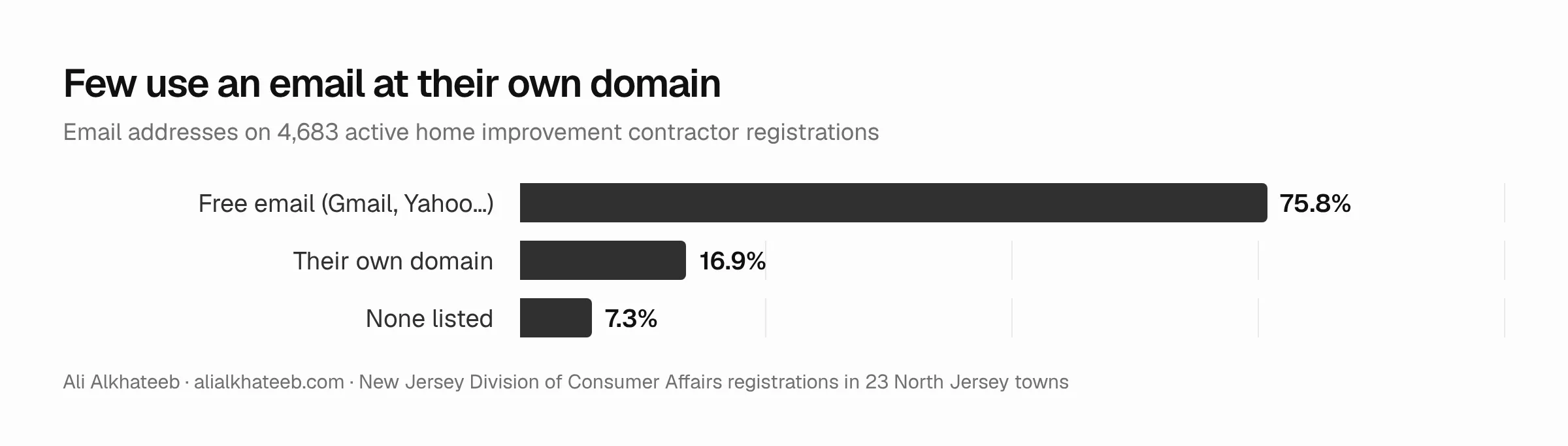
A free email isn’t a problem by itself. Plenty of great contractors run their business from Gmail. But it’s a fair sign of how many have never set up a real home of their own online.
The basics are mostly there
Of the 422 websites:
- 94% load securely.
- 94% fit a phone screen.
- 98% have a quote form, a contact page or an email link.
- 87% sent their homepage in under two seconds.
The median score was 81 out of 100. 124 sites scored 90 or more, and 18 scored under 50.
The one basic that’s often missing is tap to call. 3 in 10 sites have no phone number you can tap to call. For a contractor, that’s the most expensive miss on the list. Most people looking for one are on a phone, and they want to call.
Put together, about 1 in 3 sites miss at least one of the three basics: a secure connection, a page that fits phones, and a number you can tap.
What Google and AI read is missing
The bigger gaps are the ones nobody sees on the page.
- 51% have no usable search description, the short summary Google often shows under the link. Without one, Google picks some text from the page.
- 49% leave most of their photos undescribed. A search engine can’t see a finished kitchen. The few words of description are how it knows what’s there.
- 46% show no preview when shared. Text the link to someone and they get a bare address instead of a picture.
- 45% don’t describe the business in the format search engines read: name, phone, address, hours. It’s the plainest way to tell Google and AI tools who you are and where you work.
- 25% have no main heading, and 21% have a page title that doesn’t help: missing, just “Home”, or too long to show.
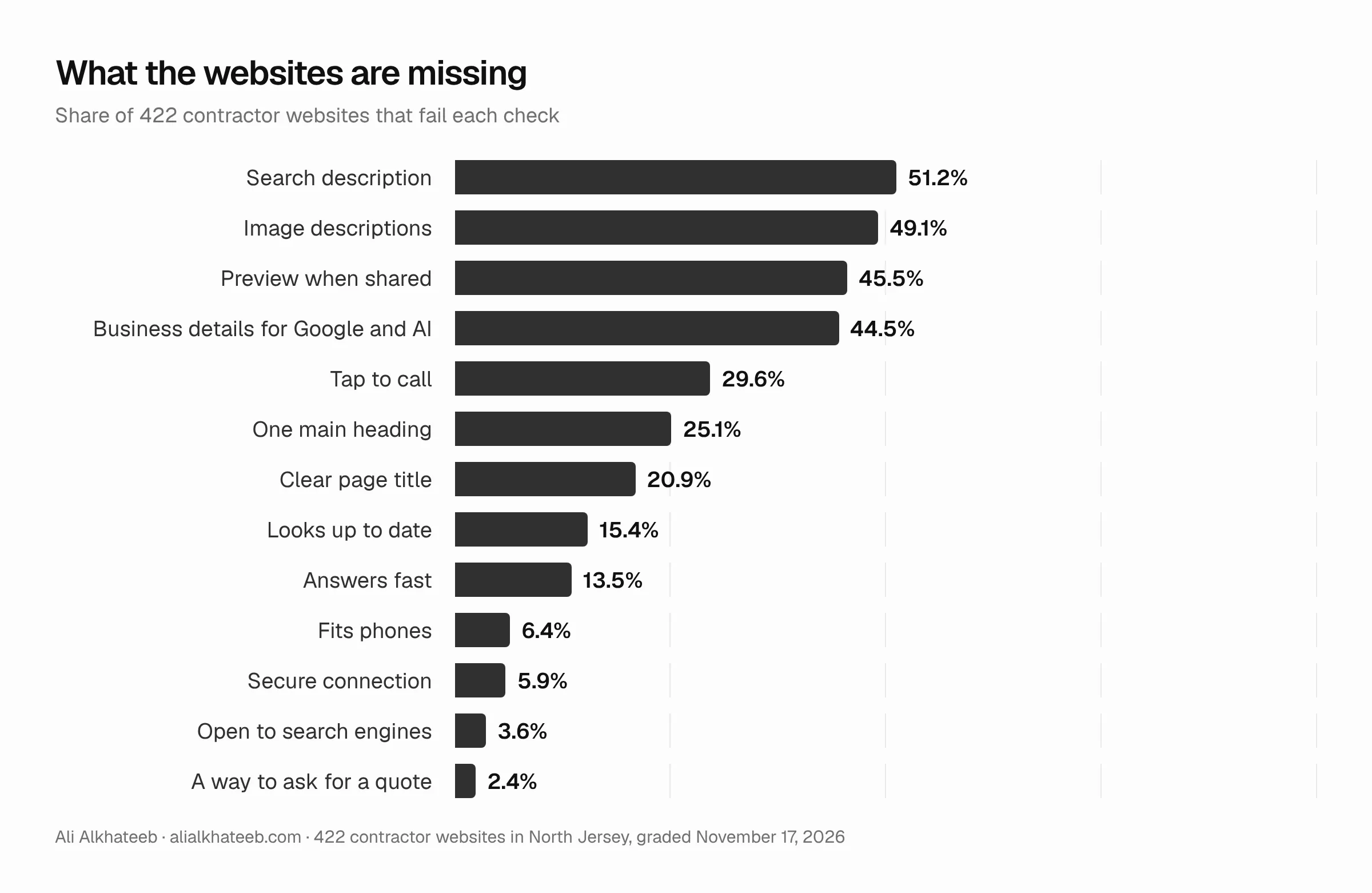
These matter more every month. When someone asks ChatGPT or Google for a roofer near them, the answer comes from what pages say about themselves. A site that doesn’t say it clearly is easy to skip.
15 sites ask Google not to list them
15 sites tell search engines to leave them out of results. On WordPress, the usual cause is one box: Settings, then Reading, then “Discourage search engines from indexing this site”. It gets ticked while a site is being built, and nobody unticks it.
About 4 in 10 of these sites run on WordPress. Wix, Squarespace and GoDaddy’s builder make up most of the rest that I could identify.
Five fixes worth an afternoon
- Make the phone number a link you can tap. On most builders, it’s a link to
tel:followed by your number. - Write a page title that says what you do and where, like “Roofing in Wayne, NJ” instead of “Home”.
- Write a one or two sentence search description for the homepage.
- Add your business details in the format search engines read. Most site builders and SEO plugins have a section for your business name, address, phone and hours.
- Describe your photos. “New cedar deck with stairs to the yard” tells Google far more than “IMG_2041”.
Also check the year in your footer. 65 sites still show 2024 or earlier, which makes a business look closed.
Why it matters
I wrote in The AI revolution hasn’t started that most businesses haven’t touched AI. This is what that looks like up close. Before AI can do anything for a lot of these businesses, their websites need to say clearly who they are.
All the numbers
| Check | Sites that fail | Share |
|---|---|---|
| Search description | 216 | 51.2% |
| Image descriptions | 207 | 49.1% |
| Preview when shared | 192 | 45.5% |
| Business details for Google and AI | 188 | 44.5% |
| Tap to call | 125 | 29.6% |
| One main heading | 106 | 25.1% |
| Clear page title | 88 | 20.9% |
| Looks up to date | 65 | 15.4% |
| Answers fast | 57 | 13.5% |
| Fits phones | 27 | 6.4% |
| Secure connection | 25 | 5.9% |
| Open to search engines | 15 | 3.6% |
| A way to ask for a quote | 10 | 2.4% |
| Score | Sites |
|---|---|
| 90 to 100 | 124 |
| 70 to 89 | 199 |
| 50 to 69 | 81 |
| Under 50 | 18 |
How I did it
- The list. Active home improvement contractor registrations from the New Jersey Division of Consumer Affairs, for 23 towns, as of September 2026.
- The websites. Matched to those registrations during research for my agency, alstro. That gave 479 sites. I run an agency that builds websites for businesses like these, so read this with that in mind.
- The grading. On November 17, 2026, the grader visited each homepage once, the way a browser does on a first visit, four at a time, with a label saying who it was. 57 sites didn’t load or didn’t answer in time, so they’re left out. That leaves 422.
- The limits. Only the homepage was checked, so a site may have a quote form or a phone link on another page. Speed is the time the homepage took to arrive over one connection, not a full browser test.
- No names. No business is named here, and none will be. Every number is a total.